My Final year project took a while to be published here as, to be honest, I had completely forgot about it. Finishing this took an extra year and I went on an independant internship and delayed my graduation by a year to partake in a project in the Royal Botanial Gardens Kew.
The project in Kew was incredible and I enjoyed my work there, when I returned for my final year my intention was to continue my work using the college resources that differed from what I had in London. The work in London has been heavily computer science based and was the exploratory phase for a larger part of this project so my hope was to look at the digital humanities aspects of this to expand upon them and flesh out the content of what I had already spent a year doing. This did not happen and I ended up having to focus solely on the computer science aspect after being assigned a data modeller as my supervisor instead of a humanities academic so really got little to no helpful support at all. However, a project still came of it and I will add the introduction below for any interested as well a link to the Final report. This project is something I tinker with from time to time still but there have not been any major updates since May 2024.
The Porject was Titled ‘Creating Humanistic interfaces for complex scientific networks‘
Introduction
The project was started within the department of Digital revolution in Kew’s Science directorate 1by myself and my supervisor, Dr. Nicky Nicolson. It began as a year-long proposal and has had enough support and interaction from external researchers that we have decided to continue on it voluntarily so as to ensure the ideas we have formed and developed came to fruition. This Digital revolution Department within Kew works closely with the digital humanities department in its partner colleges to ensure it can create new and accessible ways to mobilise our data while being in touch with new technologies.
The main research question being” Developing human interfaces for complex scientific networks” which will be the continuation of the work done in Kew by way of making a humanistic interface for the data developed so that those outside of the main research audience use this data and interact with it in a meaningful way. To understand why we need to get to the point of making this data accessible, beyond the fact that we should try to make all data in some way accessible, we need to look at the development and creation of the initial data tool that started in Kew and has continued into this time.
“A network model approach to understanding the global institutional distribution of type specimen data”.
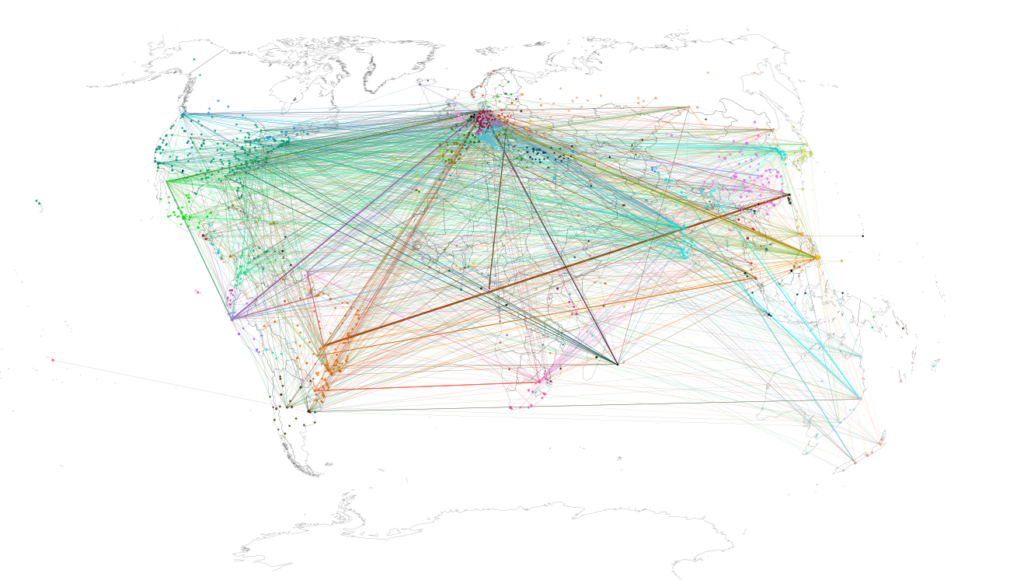
The project developed as we pursued it and incorporated the input of other scientists and institutions. For context, About 2000 new plant species are published annually via a code governed process. Each description cites a set of type specimens, these are scientific specimens used to describe a new plant species, linking the abstract name to a concrete object. The members of type specimen sets are usually held in different institutional collections, often in different countries. When institutions share material from a specimen set, they share an interest and can be modelled as linked nodes in a network. Specimens are being digitised and aggregated to maximise access and reuse, but there is a mismatch between areas of high biodiversity (global south) and locations of science infrastructure (collections, labs) due to colonial history. Progress varies throughout institutions and digital representation is incomplete. This project applied dynamic network modelling to analyse specimen data from Open Access platforms such as:
• IPNI (International Plant Names Index) 2
• GBIF (Global Biodiversity Information Facility)3
• Index Herbariorum(New York Herbarium)4
These 3 data sources were chosen due to them being open source as well as wealthily populated with data. IPNI is based on Index Kewensis (originally funded by Darwin), the IPNI project editorial team record data from published protologues, standardise authorship and (since c 1997) record type specimens. This platform acts as a record base for validly published specimens around the world.
GBIF contains information on all digitised records, which although is a majority of them it does not cover all bases as many herbaria haven’t the resources to digitise their entire collections. GBIF is maintained by a number of different institutions and governments. The data is collected via crawling and is first moved from multiple different sources to a Darwin Archive Core database then onto the GBIF servers. The coding tool after it was made does output the findings of the analyses into DWCA files which are compatible with the GBIF databases and get regularly rerun and updated onto their servers.
Index Herbariorum is a project developed by the Steere Herbarium in the New York Botanical Garden. This acts as a record of the world’s active herbaria, containing information regarding location, collections, staff, etc. These resources are continually updated and improved upon by their respective teams which helps contribute to the sustainability of this project. Every Herbarium has what we call a herbarium code(type_holder_code in the scripts), this is a code assigned by the world biodiversity forum and council after their registration as a Herbarium, these codes are assigned to the specimens held within these institutions as a way to track them, over time these code get duplicated or transferred as institutions shut down or merge together and often the specimen information will have notes about this in the exploded specimen information however in some cases, because the community is so small and connected, it requires someone to pick up a phone and call another researcher to ask where that specimen they collected twenty years ago has ended up and update the records by hand.
This interactivity by the community and open communication allowed for this project to flourish when we ensured that it was regularly shared in our internal forums and at conferences with other researchers to ensure we could continually receive feedback and wants from others in the community for the tool. We are all aware that the distribution of these important specimens was going to be inherently skewed towards past colonial and imperial powers but no one had yet to bring all that data together, clean and verify it against other sources and make it easily accessible for the research of others. The tool that was created was never meant to end up as something with a User Interface but as something that could assist other researchers in our field to continue their work and analysis in new and interesting ways.
Now being in Digital humanities does mean that everyone wants a UI for all data that someone might find useful, which is where the continuation of the above project comes in. The data output from the tool after it cleans and strips everything, then renders the network, is not in any way clear to those who aren’t in this very niche field of research. This is something that never bothered us in Kew as we knew what we were doing and quite honestly didn’t think anyone outside our field would be interested in using our data or findings and those within our field would have no issue understanding and navigating these complex files with tens of thousands of data points. The main point of this project was not to actually make an incredibly pretty and perfectly functioning web interface that would show exactly what we had achieved in our original tool but to look at how we might translate such a complex network into a functioning tool and how to incorporate the complex levels of analysis that were able to be computed within the command line interface to an interactive online network.
Here is the link to the full report with links to visualisations and code repos:
https://docs.google.com/document/d/1SDfVE3l_96MjIlQbRrRXseWEHt10ECoIl3xKjLo0ocw/edit?usp=sharing