Final Year Project intro

My Final year project took a while to be published here as, to be honest, I had completely forgot about it. Finishing this took an extra year and I went on an independant internship and delayed my graduation by a year to partake in a project in the Royal Botanial Gardens Kew.

The project in Kew was incredible and I enjoyed my work there, when I returned for my final year my intention was to continue my work using the college resources that differed from what I had in London. The work in London has been heavily computer science based and was the exploratory phase for a larger part of this project so my hope was to look at the digital humanities aspects of this to expand upon them and flesh out the content of what I had already spent a year doing. This did not happen and I ended up having to focus solely on the computer science aspect after being assigned a data modeller as my supervisor instead of a humanities academic so really got little to no helpful support at all. However, a project still came of it and I will add the introduction below for any interested as well a link to the Final report. This project is something I tinker with from time to time still but there have not been any major updates since May 2024.

The Porject was Titled ‘Creating Humanistic interfaces for complex scientific networks‘

Introduction

The project was started within the department of Digital revolution in Kew’s Science directorate 1by myself and my supervisor, Dr. Nicky Nicolson. It began as a year-long proposal and has had enough support and interaction from external researchers that we have decided to continue on it voluntarily so as to ensure the ideas we have formed and developed came to fruition. This Digital revolution Department within Kew works closely with the digital humanities department in its partner colleges to ensure it can create new and accessible ways to mobilise our data while being in touch with new technologies. 

The main research question being” Developing human interfaces for complex scientific networks” which will be the continuation of the work done in Kew by way of making a humanistic interface for the data developed so that those outside of the main research audience use this data and interact with it in a meaningful way. To understand why we need to get to the point of making this data accessible, beyond the fact that we should try to make all data in some way accessible, we need to look at the development and creation of the initial data tool that started in Kew and has continued into this time. 

“A network model approach to understanding the global institutional distribution of type specimen data”. 

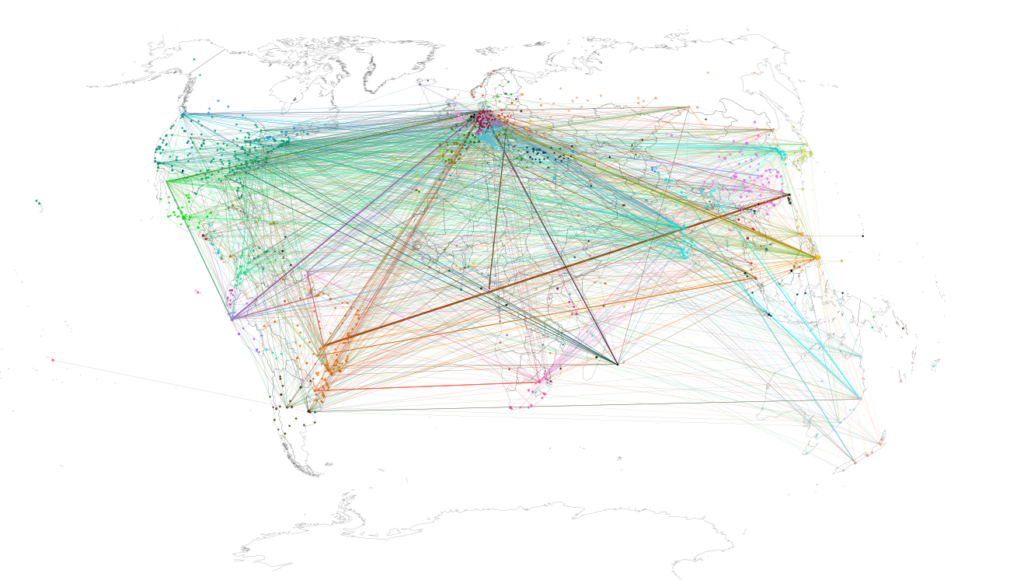
The project developed as we pursued it and incorporated the input of other scientists and institutions. For context, About 2000 new plant species are published annually via a code governed process. Each description cites a set of type specimens, these are scientific specimens used to describe a new plant species, linking the abstract name to a concrete object. The members of type specimen sets are usually held in different institutional collections, often in different countries. When institutions share material from a specimen set, they share an interest and can be modelled as linked nodes in a network. Specimens are being digitised and aggregated to maximise access and reuse, but there is a mismatch between areas of high biodiversity (global south) and locations of science infrastructure (collections, labs) due to colonial history. Progress varies throughout institutions and digital representation is incomplete. This project applied dynamic network modelling to analyse specimen data from Open Access platforms such as: 

• IPNI (International Plant Names Index) 2

• GBIF (Global Biodiversity Information Facility)3

• Index Herbariorum(New York Herbarium)4

These 3 data sources were chosen due to them being open source as well as wealthily populated with data. IPNI is based on Index Kewensis (originally funded by Darwin), the IPNI project editorial team record data from published protologues, standardise authorship and (since c 1997) record type specimens. This platform acts as a record base for validly published specimens around the world. 

GBIF contains information on all digitised records, which although is a majority of them it does not cover all bases as many herbaria haven’t the resources to digitise their entire collections. GBIF is maintained by a number of different institutions and governments. The data is collected via crawling and is first moved from multiple different sources to a Darwin Archive Core database then onto the GBIF servers. The coding tool after it was made does output the findings of the analyses into DWCA files which are compatible with the GBIF databases and get regularly rerun and updated onto their servers. 

Index Herbariorum is a project developed by the Steere Herbarium in the New York Botanical Garden. This acts as a record of the world’s active herbaria, containing information regarding location, collections, staff, etc. These resources are continually updated and improved upon by their respective teams which helps contribute to the sustainability of this project. Every Herbarium has what we call a herbarium code(type_holder_code in the scripts), this is a code assigned by the world biodiversity forum and council after their registration as a Herbarium, these codes are assigned to the specimens held within these institutions as a way to track them, over time these code get duplicated or transferred as institutions shut down or merge together and often the specimen information will have notes about this in the exploded specimen information however in some cases, because the community is so small and connected, it requires someone to pick up a phone and call another researcher to ask where that specimen they collected twenty years ago has ended up and update the records by hand.

This interactivity by the community and open communication allowed for this project to flourish when we ensured that it was regularly shared in our internal forums and at conferences with other researchers to ensure we could continually receive feedback and wants from others in the community for the tool. We are all aware that the distribution of these important specimens was going to be inherently skewed towards past colonial and imperial powers but no one had yet to bring all that data together, clean and verify it against other sources and make it easily accessible for the research of others. The tool that was created was never meant to end up as something with a User Interface but as something that could assist other researchers in our field to continue their work and analysis in new and interesting ways. 

Now being in Digital humanities does mean that everyone wants a UI for all data that someone might find useful, which is where the continuation of the above project comes in. The data output from the tool after it cleans and strips everything, then renders the network, is not in any way clear to those who aren’t in this very niche field of research. This is something that never bothered us in Kew as we knew what we were doing and quite honestly didn’t think anyone outside our field would be interested in using our data or findings and those within our field would have no issue understanding and navigating these complex files with tens of thousands of data points. The main point of this project was not to actually make an incredibly pretty and perfectly functioning web interface that would show exactly what we had achieved in our original tool but to look at how we might translate such a complex network into a functioning tool and how to incorporate the complex levels of analysis that were able to be computed within the command line interface to an interactive online network. 

Here is the link to the full report with links to visualisations and code repos:

https://docs.google.com/document/d/1SDfVE3l_96MjIlQbRrRXseWEHt10ECoIl3xKjLo0ocw/edit?usp=sharing
Spatial Humanities

The thought of participating in a volunteer led movement that could better communities was beyond exciting when I first came to know that was what we would be doing for this assignment, although when I sat and talked with others and thought about what this actually was I realised that I have been doing my own smaller versions of this for years. Be it Coderdojo or teaching cooking classes to children in disadvantaged areas, it may sound a bit up myself but I have been doing smaller scale community led programs for years and so have many people, anyone who ever took part in a daffodil day or taught at one of the mass dojo’s. We just never think about it in the context of what we’re doing will actually better others lives and make a change, we’re doing it because we enjoy being a part of something and doing little things to help.

It becomes daunting when the digital aspect is brought into it as we all know going into this that what we do will be there forever and it is extremely hard to go back on what we’ve done should we make a mistake, mistakes in mapping could cost time and potentially end up being detrimental in an emergency situation. We have the narrative that everything we put online is there forever, and it is, which always make us so apprehensive when it comes to engaging online and making and contribution in online communities because we have some form of impostor syndrome and feel that we as students are not properly qualified to do this as we have not been given the affirmation of a degree that we are capable to make a change in this world. For me at least when I sat and thought about it is what I thought might be the reason for me personally being scared going into this, I’ll go into more depth on this in the implications part or this post as I have a theory that pertains to the fear of making a change.

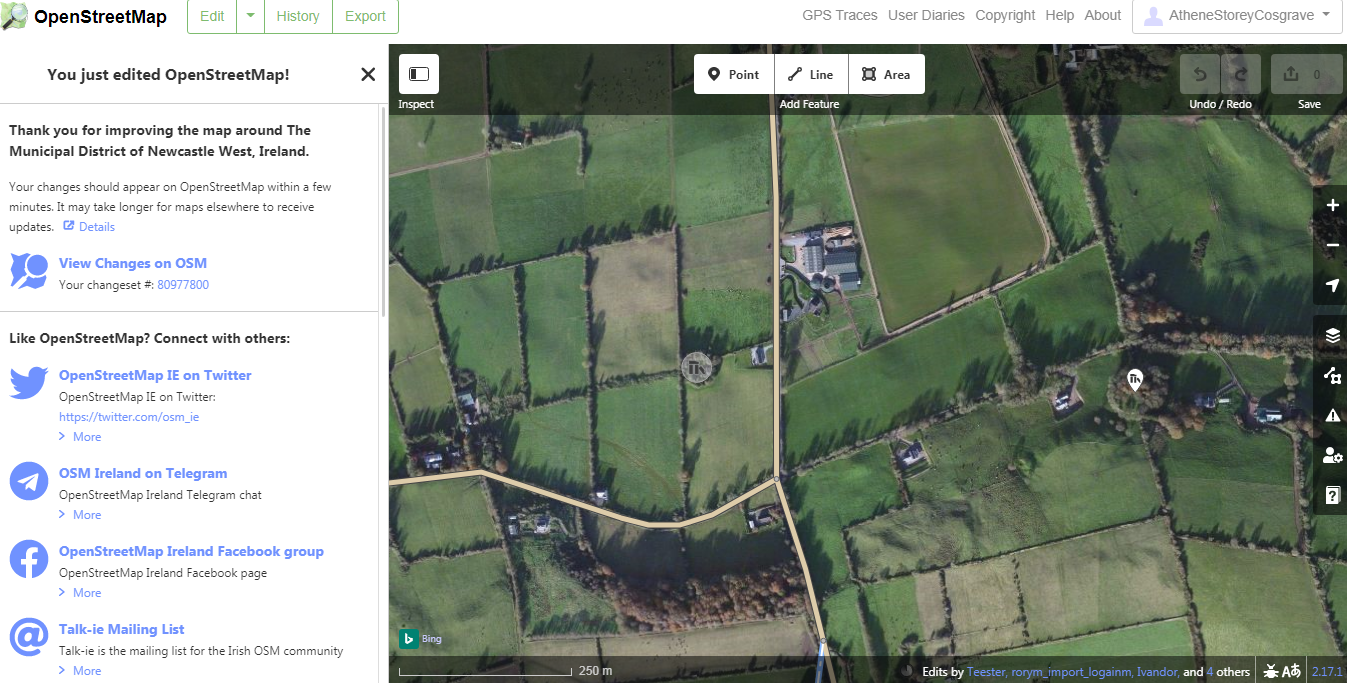
When it comes to the process I took in the project, I initially went straight to OSM as it had seemed but more exciting to me than MapSwipe, sadly my first impression of the interface and the editing methods were not great. I felt that the user interface was a bit complicated, although once I returned to it after having used MapSwipe for a while I realised that I had been making excuses to procrastinate and not use it as it was a slightly more mentally engaging piece of software.

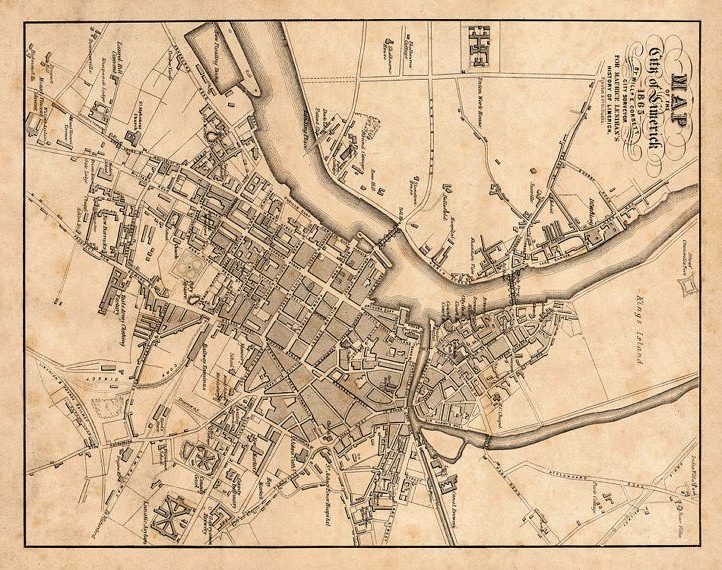
Most of my work was done on MapSwipe as I could sit and go through it fast and not have it be my sole focus in a situation, for example Netflix have been releasing the Ghibli movies so my week nights were spent watching those with my little sister while I swiped away on my tablet. When I did eventually get around to using OSM properly and sitting down to look at it I realised what an amazingly easy and lovely piece of software it was. Where I live in Cork currently is extremely well mapped so there wasn’t anything to do there really and it wasn’t where I had grown up so I didn’t have the knowledge to mark out local heritage sites and monuments. Limerick however, is a while other story, I know the nooks and crannies of my local area and could see a map from 200 years ago and tell you where everything is in relation to today but something didn’t feel right in intricately mapping my home area. it was too private, something felt intrusive about mapping my neighbors houses and farms, all I could bring myself to do in the end was doing mapping of the ring forts around my house which is quite a lot, 40 within a 5 mile radius. What kept coming to mind was that these were the homes of people I’ve known for 20 years now and what if someone used this information to try and rob them or use it for nefarious purposes, I couldn’t bring myself to do more as I was so scared about putting this information out there.

Implications! I have had a whole lot of thoughts on this and the fear around making changes and contributing to open street map, to be honest I initially had these thoughts in regards to fellow students of mine being apprehensive about voting and then related it to my fear of adding to OSM. Now we are going to go down the rabbit hole that is the mind of 4 am Athene.

From our very beginnings we have most of our decisions made for us by higher authorities and in most cases we don’t see those decisions having an impact on anyone but ourselves. Now when we go to college the shock of now having to make pretty much all your decisions for yourself is jarring for most, eventually you get over as you once again have the realisation that these choices pretty much only affect you and your life. (This thought process was initially about voting so we’re just gonna go with that and I’ll tie it all together) When we’re asked to vote we are asked to make a decision that is going to have an effect on the millions of people and most people will use the excuse of they don’t think their vote makes a difference when in reality subconsciously they’re brain is freaking out because if they’ve only just recently become accustomed to making decisions for themselves how are they supposed to be able to comprehend making decisions that will affect the rest of the country and its inhabitants. Until people realise that every single decision they make has an affect on the world around them they won’t really ever be comfortable making huge decisions like that, hopefully they’ll grow up and realise that even if they don’t want to, that they should have their voice and input heard but I have had that argument far too many times over the last 9 weeks. When it come to tie-ing the altogether with people’s apprehension towards using OSM, it’s the same concept, this is not a huge decision but it is a choice to make an contribution that could in turn affect the way someone interacts with the world around them and who knows, it could have a negative or positive impact on the community but we have to be aware and be face to face with the fact that what we’re putting out there is for others to use in a good way but it may get used by others for damaging purposes. You won’t know but it’s worth the chance because that extra road you map could save an old person who live in an old house slightly off the beaten track that isn’t mapped on google but you went and marked it on OSM and an ambulance was able to get to them in an emergency.

I thought I myself had gotten over this fear of making a change as I’ve been so heavily involved in voter drives and always encourage others to vote but from this experience I guess I will have to go through that process for each new decision I make. A nice thing I found out from this was actually a new tool that is used by the geography students in college called ESRI collector, which is a mapping app used to gather data whilst doing fieldwork and My whole jam is using digital tools in education at all levels so this was an extremely exciting discovery. Now I haven’t been able to find much online about how it work exactly and I’m going to have to take some time to use it but I didn’t have the time to look over it before I was to finish this. I have a few friends who have used it for their class who are in the college and I will be asking them about what they thought about from just a regular students perspective rather than that of a student like me who uses digital learning tools on the daily. I think learning from others experience will allow me to understand what we in DH need to do to make the digital tools we contribute to more accessible for academics not in DH

We use crowdsourcing every day. The internet is nearly completely crowdsourcing, it was created to be an ongoing project that billions of people take part in developing and contributing to. If you have put anything on the internet you have made a contribution to a huge crowdsourced project. People don’t realise that they are all involved in the development of the internet and its ever-changing, ever-growing entity that is the internet, I don’t need to try to figure out how I will use it in my day to day because I already do, now obviously there are more niche projects to be involved in like CoderDojo, which is more real life based rather than online( at least it was when I taught there) but it is solely volunteer ad person led and we rely on the help and goodness of others to take their time to help teach a few kids scratch or HTML. I do feel as though I need to interact with much smaller projects, I enjoy interacting with the online historical sewing community and contributing theories and information but part of me feels I’m not doing enough to better those who also interact with these communities.

I’ve actually remembered something I created at a hackathon in Glasgow called “Community lost, Capitalism found” which was looking at derelict or abandoned buildings in the local area and we would gather stories from the local people about what the community was like when these buildings or industry were active and helped the people who lived there and it would also look at gentrified areas that had taken these community gems and put a high-rise or terraced houses in their place that wasn’t being used, which would eventually lead to tours led by local community groups showing the areas that had been affected and would also eventually lead to squatting events holding talks by people who had been made homeless or affected by these changes made by local government.

Portfolio of Digital and critical writing.

The game I’ve chosen doesn’t have amazing graphics nor does it have much of an open world system compared to more modern games, but it is quite a host unto itself when it comes to storytelling and character development. 

‘Fable III’ is a medieval/ steampunk based game that includes magic and whatnot ( essentially all the aspects of a well rounded fantasy game). Although not very technologically advanced for nowadays is have an amazing spin on player involvement in the game. you begin as a neutral character with not much skills or knowledge or the world your playing in except a basic mission and goal. However, this is a decision based game that works off the tree map system used in game design meaning one choice will lead to a different branch of the tree and will change how the rest of the game is played drastically. As you develop in the game and make decisions based on scenarios you’re confronted with you’re character changes from being neutral to being either and good benevolent monarch or a tyrant ( I should have mentioned this earlier but you start as a prince/princess who has to go undercover as a commoner to help stop and evil in the kingdom). I find this way of having a character develop is amazing and genius, because you can play this game countless times and never get the exact same story arc for you character each time.  while playing the game , unless you aware of this development, you don’t realise that the way your story is going is essentially a reflection of how you yourself would react in this situation and really makes you reflect on your character outcome  at the end of the game. 

I personally would say this game is one of my all time favourite games solely because of the storytelling aspect and how it twists your character as you play. not very up there in technology wise but pretty good in player interaction wise. 


I’ve decided to write a response/ review of the talk given to us in weeks 5 and 6 by Pedro Nilsson-Fernàndez re: Open access and Social Media.

Open Access

For me these were the two topics we’ve touched on in the module that I am really interested and passionate about. From a young age I was taught about open access and the freedom of information, and it is something that’s been in my mind even more so now that I’m in a environment that is so dependent on these things. I agree with the fact that we should have more open access documents and the digitisation should be a given in most cases for archiving however there’s also the fact of money. As much as we want everything to be free it just isn’t feasible with out current resources, digitisation takes a lot more time and money than most people realise and academic journals are, in some cases, the sole income for some academics. Eventually we’ll get to a time when academics are paid their dues and everyone has a better living wage but until there monetisation of knowledge is still some thing that needs to be done as a sacrifice while work on better outcomes.

Although I realise this is slightly contradictory to the point I just made, the fact that certain information is pay walled, for example: books for school and classes, basic historic archives as well as quite a large amount of general knowledge. Now, I don’t mean pay walled in the outright sense in all cases, in cases such as LSOTR we forget that all the books and journals on there aren’t openly accessible and that our capitation fees go towards paying for our use of this knowledge outlet. Which, in my opinion, creates this knowledge hierarchy among those who have attended college or an institution and those who maybe decided to pursue another path such as an apprenticeship. This alienation through academia is extremely toxic and creates further socio-economic divides that will continue if more resources aren’t made available to the general public.

Social Media

When it comes to social media there’s dozens of debates one can touch on and extrapolate. In the lecture we didn’t so much talk much about the platforms themselves but their use of our data for things such as marketing and political campaigns.

I never found it surprising that our privacy and our data was no longer our own once we embarked on our online social adventures, part of me hold the opinion that anyone who still thinks that they are able to have absolute and sure control over their own privacy and information is only fooling themselves. Sure, there are steps one can take to stop people knowing about you and attempting to keep yourself as safe a s possible but there will always be someone out there who has information on you and will distribute it whether we like to admit it or not. Of course the Cambridge analytica scandal shook people to their cores, that they were prey to psychological endeavors and were manipulated. Personally I’m just surprised they got caught, it seems like quite a sloppy job, but I mean the corporations involved have now become sloppy in their day to day goings on.

For one of the other assignments I did, I responded to an paper re: the trends in the diffusion of misinformation on social media. This was interesting and talked about the measures taken by platforms to stop the spread of ‘fake news’ on their websites and how there’s been a steady decline over the past 2 years in some websites, however, in others there been and exponential increase in the spreading of misinformation and pseudoscience in that same time period. I can see how this paper ties in to the general topic of social media and it touches more so on the finer points that we as a community need to actually focus on and bring forward an awareness of. There’s also a certain level of acceptance that needs to be had among us that, we as a people most likely cannot change what will happen with our data in the near future nor can we stop our information getting out but that we can work on making sure future generations have some forms of security and safety concerning these matters

*From my writings on canvas and my website I only had around 1000 words so I will be essentially be writing a small piece on what I did for my presentation in class as I realise I was not clear enough about it when talking to people who do not know much about historical recreation.

The Symington Collection

The Symington Pattern Collection is a online archive of original patterns from the Symington Corset factories. The Archive was digitised only a few years ago but gained much popularity in the world of historical garmenting. I will go into a brief explanation as to why this was such an important step in digitisation.

Usually when we think of digitisation we think of only academic uses or for museum exhibitions. With this collection we are seeing it being used in a more practical open source manner that doesn’t alienate people with the thought of it being a solely academic archive. Now for us costumers it is academic in a way as we will study and note on it the same as a professor would a manuscript, however many of those in our area were self taught and may not have gone to a university or other academic institution to study historical textiles and construction. This archive allows those of us who do not have the resources that others in institutions might have. The archive is free and the pieces may be freely downloaded, you can also buy to scale prints of the pieces should you not be able to completely redraft is with your skill set.

This is just one way digitisation was used to benefit a certain group but it could be used in so many different ways. Currently most of what we work off of is books that researchers have spent years putting together and piecing into existence. For example, Janet Arnold was a fashion historian and spent the last 25 years or so of her life recreating patterns of historical garments to put into a book so that those who weren’t able to access these resources could get them and do their own work. For quite some time Janet’s books were pretty much all we had until open source books and high quality imaging came around and the freedom of knowledge became more widely spread. Now thankfully we have platforms and online free institutes that are making partnerships with museums to get more patterns digitised and to allow for high quality imaging of pieces that in previous years you would have had to waited to see. One in particular is the Peacock Dress by the Worth fashion house made c.1890. The Worth gown mentioned is one of the most elusive gowns of it times and still is today for those in the recreation business. The dress was embroidered with gold and silver fibres and over time those have rusted and begun to damage the Indian silk the dress was made from. Two dress historians (Cathy Hay and Bernadette Banner) have taken up the task of re-creating the original gown and have in turn begun gathering extremely high quality imaging of the dress and its exquisite embroidery.

The original embroidery on the gown which had rusted due to the metallic fibres.
A sample done by Cathy Hay of what the original embroidery looked like, which took 9 months to embroider by hand, were the dress to be done is the same manner it would take 30 years to embroider the whole gown. However, there is a specific way or embroidery used by the silk factories that means it can be done in 9 months by these skilled artisans.
As you can see the gown has lost quite a bit of lustre since it creation and the only way to see it in its original light is to recreate the whole dress from start to finish.

Bibliography: 

  1. Allcott, Hunt, Matthew Gentzkow, and Chuan Yu. “Trends in the Diffusion of Misinformation on Social Media.” Research & Politics 6, no. 2 (April 1, 2019): 2053168019848554. https://doi.org/10.1177/2053168019848554.
  2. “Foundations Revealed – Foundations Revealed.” Accessed December 20, 2019. http://foundationsrevealed.com/.
  3. The School of Historical Dress. “JANET ARNOLD ARCHIVE.” Accessed December 20, 2019. http://theschoolofhistoricaldress.org.uk/?page_id=124.
  4. Image Leicestershire. “Symington Corset Pattern 1906-07.” Accessed September 22, 2019. https://imageleicestershire.org.uk/view-item?i=18702.
  5. Cathy Hay. “The Peacock Dress Today.” Accessed December 20, 2019. https://thepeacockdress.com/project/the-peacock-dress-today/.

Response to lectures (week 1-6)

I’ve decided to write a response/ review of the talk given to us in weeks 5 and 6 by Pedro Nilsson-Fernàndez re: Open access and Social Media.

Open Access

For me these were the two topics we’ve touched on in the module that I am really interested and passionate about. From a young age I was taught about open access and the freedom of information, and it is something that’s been in my mind even more so now that I’m in a environment that is so dependent on these things. I agree with the fact that we should have more open access documents and the digitisation should be a given in most cases for archiving however there’s also the fact of money. As much as we want everything to be free it just isn’t feasible with out current resources, digitisation takes a lot more time and money than most people realise and academic journals are, in some cases, the sole income for some academics. Eventually we’ll get to a time when academics are paid their dues and everyone has a better living wage but until there monetisation of knowledge is still some thing that needs to be done as a sacrifice while work on better outcomes.

Although I realise this is slightly contradictory to the point I just made, the fact that certain information is pay walled, for example: books for school and classes, basic historic archives as well as quite a large amount of general knowledge. Now, I don’t mean pay walled in the outright sense in all cases, in cases such as LSOTR we forget that all the books and journals on there aren’t openly accessible and that our capitation fees go towards paying for our use of this knowledge outlet. Which, in my opinion, creates this knowledge hierarchy among those who have attended college or an institution and those who maybe decided to pursue another path such as an apprenticeship. This alienation through academia is extremely toxic and creates further socio-economic divides that will continue if more resources aren’t made available to the general public.

Social Media

When it comes to social media there’s dozens of debates one can touch on and extrapolate. In the lecture we didn’t so much talk much about the platforms themselves but their use of our data for things such as marketing and political campaigns.

I never found it surprising that our privacy and our data was no longer our own once we embarked on our online social adventures, part of me hold the opinion that anyone who still thinks that they are able to have absolute and sure control over their own privacy and information is only fooling themselves. Sure, there are steps one can take to stop people knowing about you and attempting to keep yourself as safe a s possible but there will always be someone out there who has information on you and will distribute it whether we like to admit it or not. Of course the Cambridge analytica scandal shook people to their cores, that they were prey to psychological endeavors and were manipulated. Personally I’m just surprised they got caught, it seems like quite a sloppy job, but I mean the corporations involved have now become sloppy in their day to day goings on.

For one of the other assignments I did, I responded to an paper re: the trends in the diffusion of misinformation on social media. This was interesting and talked about the measures taken by platforms to stop the spread of ‘fake news’ on their websites and how there’s been a steady decline over the past 2 years in some websites, however, in otheres there been and exponential increase in the spreading of misinformation and pseudoscience in that same time period. I can see how this paper ties in to the general topic of social media and it touches more so on the finer points that we as a community need to actually focus on and bring forward an awareness of. There’s also a certain level of acceptance that needs to be had among us that, we as a people most likely cannot change what will happen with our data in the near future nor can we stop our information getting out but that we can work on making sure future generations have some forms of security and safety concerning these matters

css.php